Showing posts with label posted by Davin. Show all posts

Wednesday, October 17, 2012

Looking Back

After a few months back in the US, I am finally sitting down to conclude my reflections on our year in Norway. From where I am sitting now, it seems almost like a dream. Sending in my application for the Fulbright. Being surprised by the award notification. Juggling the excitement of the opportunity with the responsibilities of family. Coping with morning sickness. Packing our home into boxes. Culling years of accumulation from our closets. Finding a place to live. Squeezing everything into one bag per person. Saying goodbye to everyone. And then taking that step into uncertainty...

I learned a lot in a year. Not just about Norway. Not just about digital culture and electronic literature. I learned about my family, my children, my spouse, myself. Some of it I always knew, but really came to me in a deep way. There are many things in life that seem important--Jobs, bills, paperwork, appointments, deadlines, desires, ambitions, etc. Being separated from my daily routines and habits and patterns of thinking, and feeling a keen responsibility for my children, who are at the continual mercy of adult decisions, gave me a new appreciation for their courage and character. For Carrie and me, the chance to live in another country for any amount of time is a luxury and privilege. But for Jonah, Oscar, and Sergio, the move was a bit more radical.  To a child, a year seems like an eternity. A neighborhood full of children who do not speak your language can be a frustration. A new diet. New social norms. Even different bedrooms. These upheavals can seem so big. Nevertheless, I got to see each of them adapt with wonder and courage to the tectonic shift I had introduced to their world. In spite of their dynamism, I came home each day to find my arrival anticipated, my presence needed, my attention required. We have always lived closely as a family, but somehow, I found myself being drawn even closer.

I was happy to discover that this is something very valuable to Norwegians. Parents are expected to take leave of their professional obligations to be with young children. Workdays are shorter. Vacations more frequent. Time, it seems, is more precious there. Back home, I feel like time is a commodity. If I were less fortunate than I am, I might have to choose each day between bread on the table and a seat at the table. Carrie would have to do this, also. In Bergen, I felt as if time were priceless. Maybe it's the romance of living in an old city and a coherent culture.

Already, I feel myself slipping back into many of my old habits. Long days. Frenetic pacing. Measurement and output. But I am not so complacent in this as I once was.  The claims that my career have placed on my heart have been weakened, and the claims of family, friendship, and community have grown stronger. Furthermore, I feel committed to bringing what I learned from Norway back home, to my community. To engage, not through an abstract sense of justice or a
sense of anger, but through a sense of hope and the realization that our arrival is always anticipated, our presence always needed, and our attention always required.  Our world can change, and change can be met with anxiety and curiosity, but it can always be made better if we only take the time to draw the world ever closer, to hold each other more, and to choose to behave as though our days matter.

Sunday, June 24, 2012

Midsummer


Nikolai Astrup, Midsummer Eve Bonfire, undated, oil on canvas, 60 x 66 cm. Courtesy of the Bergen Art Museum.
If you are familiar with the work of Nikolai Astrup, chances are you have seen a painting of a Norwegian Midsummer celebration.  A holdover from pre-Christian times, Midsummer coincides with the solstice, making it the longest day of the year.  While Midsummer has been historically celebrated throughout Europe, in the Northern countries where the longest day can be very long, the experience of this day strikes a sharp contrast to the darkest day of the year, which explains why even in our caffeine fueled, electrically illuminated world, it is still widely celebrated.  In Bergen, the sun was above the horizon for 19 hours, with twilight in between, as compared to the darkest day which was a dim and cloudy 4 hours of the most meager light.  In Christian times, Midusmmer survived in Norway as Sankthans or Jonsok (June 24th), named for St. John the Baptist, and is celebrated with a bonfire on the evening of June 23rd.

Growing up in Los Angeles, with bright sun and warm weather year round, I took the sunlight for granted and never really grasped the concept of seasons.  The long days in Norway make everything grow really fast and the light and heat bring everyone out into the streets, late into the evening, making it a wonderful time of year.  

Firefighters ascending the tower of barrels to ignite the top.
On the 23rd, we walked down the hill to Laksevåg to witness a giant tower of barrels go up in flames.  It is actually the largest barrel bonfire in the world (around 18 meters tall).  The boys were pretty nervous to watch the firefighters climbing the tower to set it on fire, but it took a while for the blaze to really take off.  
Jonah and Oscar admire the inferno.
It was about 10pm when things got started and, as the tower burned, the mood slid into a sort of delirium...  and we went home with daylight to spare.

The fire spread quickly...


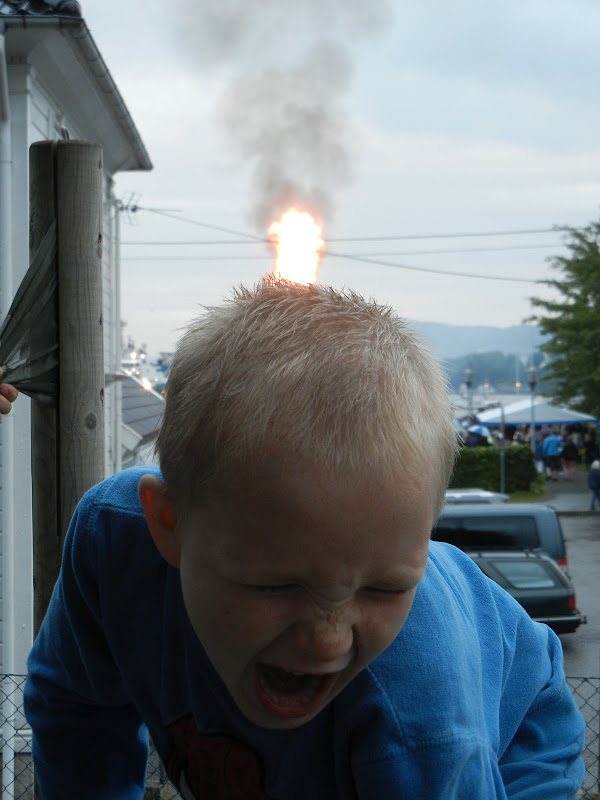
And soon it was coming out of our mouths.

Sunday, May 20, 2012

Sætregården

Our next door neighbor, Stine (pronounced "steena," a Norwegian variant of Christine), invited our family to visit her parents' farm.  Her parents, Liv and Robert, came to pick up the six of us, along with Stine and her son, Jakob.  Sætregården specializes in education, therapy, and recreation, serving a variety of communities in the Bergen area, including school children, seniors, the disabled, and horseback riding students.  Given the idyllic setting, warm hospitality of our hosts, and abundance of cute animals, it's no wonder that people want to visit.

Oscar walking up the road to the farm
When we arrived, Jakob (Stine's son) gave Jonah, Oscar, and Sergio lessons on feeding the chickens and goats.  We were surprised to discover two turkeys, one of which was very big and hilarious (I believe, and the boys agree, that turkeys are funny).
 
Jakob, showing Sergio how to feed the goats
Sergio feeding the goats
Oscar amazed by chickens
Jonah laughing at the turkeys
After feeding the goats and chickens, we went into the stable, where the boys got to visit the horses and see the newborn lambs.  They took turns feeding one of the babies.
Jonah feeding the lamb
Next, the boys took turns riding horses.
Jonah on horseback
Then, they spent some time climbing a mountain to peek into the edge of the woods.  Sergio had some pretty carefully conceived plans that involved hitting tigers, lions, and coyotes with a stick before they could eat the goats, sheep, and chickens.
Up the mountain
Stine's parents invited us in afterwards to have waffles, ice cream, coffee, and refreshments.  For the boys, it was up there with just about any birthday party.
The boys enjoying iskrem!
An extra picture of a goat....  because goats are great.

Saturday, May 19, 2012

17. mai

On May 17th, we celebrated Norway's "National Day" (or "Constitution Day"), usually referred to as syttende mai (translation: 17th of May).  We started the day early, by heading to Mass (it was also Ascension Thursday), then met up with some friends afterwards and spent the morning walking around the city center.  We knew the National Day was going to be a very big deal here.  We saw flags coming out everywhere starting at the beginning of May.  The bus routes were totally upended to accommodate the activity downtown.  And, I was a bit shocked to see some of the neighbors out into the wee hours of the night on the 16th preparing their gardens and trimming their shrubs.

Norwegians heading into the city to celebrate
But had no idea just how big it was until we saw the throngs of people converging on the city, early on a rainy morning, dressed in their finest clothes.  The most immediate difference between the 17 of May and our 4th of July is the way that enthusiasm for the day is expressed.  Everyone was wearing something classy (except us, of course, and the graduating seniors, who wore their overalls and caps).  Many were dressed in suits and gowns, but most seemed to be wearing bunads, Norwegian folk costumes.  The various designs and styles represent the specific communities with which the costumes are associated.

Jessie and Benji modeling their bunads
In the city, almost all businesses were closed, but small booths selling hot dogs, ice cream, cotton candy, coffee, and sundry treats had sprung up like a ring of mushrooms around heart of the city, feeding the festive mood of the morning.  Eventually, the parade began and people started marching through the street representing various organizations, ranging from silly to serious.
The prisons in Norway are much more relaxed than back home. 
(Actually, they are, but these are just some people marching in the parade.)
Norwegians are very athletic, even on holidays. 
(Actually, they are, but these were also just some people marching in the parade and doing aerobics).

Some of the more serious parade participants

An interesting highlight, and something specific to Bergen, is the buekorps (trans: "bow corps").  Over the past month, we have been seeing groups of kids in uniforms carrying wooden crossbows and marching to drums.  After talking with some friends here, I learned that the buekorps are part of a folk tradition in Bergen that stretches back at least 170 years.  The first buekorps were organized by boys (now they are co-ed) in Bergen and based on military exercises that they had imitated, and membership was based largely on neighborhood.  These units would train, elect leaders, plan missions against rival units, and wage "war" in the city.  While I am not entirely certain of the history and level of conflict, my understanding is that by the 1850s (perhaps, in parallel to the growing nationalism of the times), these organizations had shifted their responsibilities and migrated into more communitarian endeavors like service and "civil defense." Today, they remain autonomous, youth-run organizations, though they are largely focused on sport and social activities.  (I think this is one of the most interesting things I have noticed about Norway: Children are encouraged to develop leadership skills and a sense of responsibility.  This attitude of encouragement is matched with commitment and investment by the older generations.)  

A beukorps group preparing for the march.
After we watched the parade in the city center, we headed over to have lunch with our friends Scott, Jill, Aurora, Benji, and Jessie.  In addition to the pleasant company of our hosts and their guests, we had a nice meal (which included the traditional rømmegrøt, a thick porridge made from sour cream and served with butter, sugar, and cinnamon) and then walked with them to their neighborhood parade. 

Oscar and Jonah in the sack race...
Even in his sleep, Sergio celebrates.
Another interesting aspect of Norway's National Day was the experience of the neighborhood parade, which are organized by school district and which focus on the youth.  The parades snake through the local school district and end up at the school house, where there are games, snacks (hot dogs, coffee, cakes, ice cream, etc.), speeches about civic values, and student performances.  Sergio fell asleep by the time we reached the end of the parade route (he needed it), but Jonah and Oscar were awake to participate in sack races, tug-o-war, and tricycle races.  My favorite activity (and one which Oscar and Jonah liked) was hammering a nail into a board.

Gratulerer med dagen! (literally, "Congratulations with the day!"; used for birthdays and for May 17th)

Wednesday, February 22, 2012

Beware... Ned Trappen

We spent the last few days outside of Oslo, in Lillehammer, enjoying the company of my fellow Fulbrighters, their families, and several members of the US-Norway Fulbright staff.  The annual ski trip (which Carrie plans to blog about more thoroughly) followed a midterm research presentation at the Norwegian Foreign Office and a reception held at the U.S. Ambassador's residence in Oslo.  The midterm presentations were fascinating.  My colleagues are doing amazing things: using sound waves to monitor ocean temperatures, performing emergency veterinary medicine on wild bears, using analytic tools to predict and prevent global conflict, documenting the influence of Norwegian immigration on the culture and history of the upper Midwest, and many, many other topics.

And while I imagine many of you wish that I would tell about the happy events of the past few days, and perhaps I owe it to my readers and colleagues to dwell on these things, I will make a rare departure from my typical blogging persona to share with you a more sinister side of what was supposed to be a pleasurable and refreshing weekend.  I will tell you about our encounter with Ned Trappen, the ghost, who, according to Oscar and Jonah, haunts the Gausdal Resort in Lillehammer.
On Friday afternoon, mainly to keep the children from wasting their time playing Wii in the hotel's recreation room, I encouraged Oscar, Jonah, Kayla, and, later, Anders, take some time to explore the hotel.  A large complex consisting of many interconnected buildings, the Thon Hotel Gausdal at Skeikampen offers many opportunities to get lost.  In addition to the lobby, hallways and conference-style meeting rooms, there are many comfortable recreation areas, a parlor room, libraries, bars, lounges, and odd nooks.  The spaces are populated with comfortable furnishing, pianos, bookshelves, stockpiles of games, historical photographs, and old pieces of equipment, all with the potential to provide hours of investigation.  A fun way to spend a night, right?

That is, until I heard them talk about the ghost in the hotel.  Evidently, while exploring some of the more remote corners of the resort, those that are "off limits" to guests, they reported some curious findings.  First, they found a piano, that, at times, could be heard in playing in the distance.  When they went to investigate....  no one was there, at least no one they could see. 
Next, they found a reinforced door.  Why was it reinforced? It's hard to say, except that someone either wants to keep people out...  or to keep something in.
Outside the parlor room, they found an old switchboard.  Oscar mentioned that he heard something on the receiver, but when he examined the wiring, he noticed that it didn't seem to be connected to anything.
Driven now by an intense curiosity, the three decided to travel into some of the hotel's more obscure passages. They found a room that, apparently, had been disturbed by some paranormal activity.
In addition to inexplicably stacked chairs, they encountered a locked door to a dark passageway in which a faint flickering could be detected at the end.
After exploring another hallway, they came across a darkened basement passage that ended in a locked door.  This, according to Kayla, might be where they kept the coffin.
But whose coffin?  It was all made up, wasn't it?  That's what Oscar told me.  There couldn't be a ghost in the hotel, could there?  And that's when they found an important clue.
They discovered a cryptic sign that said "WC Ned Trappen."  After a bit of thinking, they discovered that this was the last Water Closet that Ned Trappen used before his accident on the ski lift many years ago.  You see, Ned Trappen was a world class skier whose body was cut in half in a horrifying ski lift accident.  His legs went skiing down the mountain.  His upper half trudges down from the mountain top every night, using his two ski poles to carry himself, looking for his legs.  They even found a picture of young Ned, taken before the tragic incident.
Of course, the kids knew they were inventing these stories out of thin air, but it did not stop them from getting fairly freaked out by old Ned.  While running away from some strange sound he heard, Oscar tripped.  With a worried look on his face, he said, "Dad, you know, Ned Trappen is just something we made up. But, weird things keep happening to me.  You know, I normally don't trip when I run.  Why would that happen now?" Later that night, his water glass, floating on a thin sheet of water, slid across the counter.  "Dad!  You know, Ned Trappen just means 'downstairs' in Norwegian.  It's not real.  But my glass just moved across the counter.  I wasn't touching it." 
Today, traces of this nonexistent character can be found everywhere, if you know how to look.  According to some, his shape even haunts the landscape of Lillehammer...

Sunday, November 20, 2011

Great chieftain o' the puddin-race!

Here are the members of the research group, from left to right: Patricia Tomaszek, Jill Walker Rettberg, Eric Dean Rasmussen, Scott Rettberg, and me (Rob Wittig went for a walk to celebrate the submission of his thesis).
This past week, my work has provided another round of new experiences....  this time, they included haggis, a distillery, and a trip to Scotland.  The Electronic Literature Research Group at UiB hosted a writer's retreat at Logie Country House, just outside of Aberdeen.  The purpose of the trip was to spend some time focusing on our various writing and grant-related projects before finals and Christmas break kick in.  As an added treat, we were joined by Rob Wittig, an artist, teacher and graduate student in digital culture, who shared a fantastic thesis on "networked improv literature" (aka netprov).  To read more on Rob's pioneering work, read this post by Rob and his fellow netprovocateur, Mark Marino.
The Maiden Stone.
While most of the time was actually spent on rather intense and focused research, we did make time to take some walks and see some local sights, including the Maiden Stone, a Pictish monument from ninth century A.D.  In addition, we made a special trip to Glen Garioch Distillery.  And, as you might guess, we enjoyed some very good scotch.
The stills.
Rounding out our intense workdays and stimulating outings, we spent each evening enjoying great meals by Scott Rettberg.  In addition to being a visionary in the field of electronic literature and an all around fine human being, he is a great chef! (In case you're wondering, he did buy a haggis from the butcher....  and I ate it and liked it.)


Monday, November 7, 2011

More Visitors in Norway!

Yesterday, I saw my parents (my mother and step-father) off from their short but wonderful visit to Bergen.  A little over two weeks ago, they arrived in Spain, where they stayed with my older brother.  Then they took a train through France and Germany, up into Denmark.  From Denmark, they took a boat to Bergen.  They spent five days here.  Then they got on a train to Oslo and caught a plane back home! As always, these visits seem always seem far too short...  and as I sit recuperating from a whirlwind visit, I am scheming at different ways to get them back to Norway.


Miraculously, the first few days of their visit were relatively warm, dry, and sunny. It was especially nice that they had the chance to see all the different types of light and color that I really enjoy in Bergen.  The sun, especially this time of year comes in at odd angles, casting long shadows.  And the air is so clear and the angle so low that it can be blinding in intensity.  When the clouds roll in, it's rarely a flat, gray mass of clouds.  Instead, it is usually an energetic, churning swirl or grays, whites, silvers, and blues.  If the sun is setting, there are pinks and oranges.  And, quite often, there are rainbows, too.  (As a side note, we went to the art museum which has a large collection of works by Nikolai Astrup, many of which of seem to capture the things I like about the light in Bergen.)


On Wednesday, we made the trip up Mt.  Fløyen.  And, once again, the view was spectacular.


On Thursday, we went to Rosenkrantz Tower, Bryggens Museum, and walked around the wharf.


Friday night, we celebrated my birthday.


Saturday, my folks went with Carrie, Jonah, and Oscar to visit a historic farm nearby, to see Norwegian Fjord horses in their native land.  I wasn't feeling well, so I stayed home with Sergio (who was also a bit under the weather).  But from what I understand, the farm was beautiful and everyone had a wonderful time.


On Sunday morning, we headed down to the train station to see my parents off.  

Friday, October 14, 2011

Mount Fløyen: The Oscar Edition

Those of you who have been following the Heckman Family's exploits in Bergen will recall that only days ago Oscar's lifelong ambition to go rock climbing had been dashed against the jagged boulders of reality, when we discovered: a) there was free rock climbing, b) it ended at 3 o'clock, and c) it was 3:10 (or 15:10, if you're Norwegian).  To make matters worse, Jonah had scaled the face only moments before.  On that afternoon, I watched Oscar walk quietly away from the stern gray wall, his eyes downcast, welling with tears, as stifled whimpers cast a pall of gloom on what was otherwise a sunny afternoon.

But, as fate would have it, his little mountaineering fantasy, battered though it was, had not died that day on Mt. Fløyen.  While we mourned the loss of a childhood dream, Fate was busy making other plans.  Oscar's school, we discovered, was closed for a staff meeting today.   The dark clouds and heavy rains of the season had been displaced by a bright blue Scandinavian sky.  And, as though enchanted by a benign, but powerful, trollmann, the Athletics Administration was offering another day of free activities.  Thus, Oscar's rock climbing ambitions would rise from their ruined state, and see him safely to the pinnacle of his dreams.*

At about 10:30 in the morning, we made our way into the city, and walked down Skostredet, which seems to mean "The Shoe Lane."  Appropriately enough, we found a building covered with shoes, which made for a nice start to our walk.

The Building on Shoe Lane
From Skostredet, we made our way up to the funicular, and as it was Friday, we were lucky.  After all, Friday is "Freia's Day," after the enormously popular brand of Norwegian chocolate.**     

Heading up Mt. Fløyen
Anxious about the 3 o'clock deadline, we made our way to the climbing place by 11 am.  Since we were the only ones there, Oscar was able to get to work climbing the mountain.  He got about 10 feet up before he decided to turn around and look where he was standing.  Very quickly, climbing gave way to a long monologue about mountain climbing, which included observations about the strength of the rope, how hard his helmet was, how competent his adult helpers were, and how safe he was on the rock face.  Eventually, he decided he'd done enough climbing, and made his way down the wall (with a little help from one of the men who was running the activity).

They let kids do cool stuff in Norway.
Oscar, still doing cool stuff.
After this climb, Oscar went in search for his own place to climb.  The new climbing spot wasn't quite as steep as the first, but a nice climb nonetheless.

Oscar's own climbing spot.
Next we hiked over to the lake where we had gone canoeing a few days earlier.  We took a lap in the canoe, then went over to the archery range to shoot some arrows.  When we had exhausted the opportunities around the lake, Oscar led me on a long meandering walk through the woods.  He found little footpaths where I thought none existed, we mucked our way through bogs, tramped across bridges, and ended up on a bench overlooking the city.  We stopped to have lunch.

Sandwich break.
We found a trail near the bench and decided to follow it down the mountain.  It wasn't the most direct path, but it took us to a great spot overlooking a reservoir.  We paused again to rest and eat some fruit leather and admire the view of Mt. Ulriken.  This was where Oscar had found a spear that someone had made from a stick. 

Oscar, with Mt. Ulriken in the background.
Oscar with the spear.
By now, we were nearing the edge of the city and, wanting to avoid the long lateral roadways that zig-zag lazily down the mountain, we went in search of shortcuts.  The best one was an abandoned staircase that ended in several missing stairs.  The path at the end of the stairway had been given over to neglect, and was little more than a narrow, craggy rut running along a precipice.  At the end of the path, we found a tree fort with a missing ladder. The perfect place for mountain climbers and spear wielding thieves to rest their weary bones.

Gaining entry to the tree fort.

On the lookout.
Somehow, we ended up on Kong Oscars Gate, which is Norwegian for King Oscar Street, a perfect way to bring our long journey to a close. 
The old city gate on Kong Oscars Gate.
We made our way to Festplassen (which means "party place"), and, what do you know, they were getting ready for a party.  Oscar was exhausted and ready to go home, but not before we noticed a miniature racetrack with little radio controlled cars.  The event was sponsored by Red Bull (a distant relation of both Ole Bull and Erik the Red) and featured cars made out of Red Bull cans.***  Oscar's was a helicopter.

Oscar, exhausted after a three mile meander.

Driving a helicopter-shaped car made out of Red Bull cans.
*Editor's Note: Actually, we knew there would be rock climbing all week.  We had planned to take him up there.  And, his ambitions only carried him partway up the cliff, because it's kind of scary, once you're up there.

**Editor's Note: Actually, Freia (Freyja, Freya) is a Norse goddess.  

***Editor's Note: This is what we in the US call a "Load of Bull."  Red Bull is an energy drink, and has no relation to the Viking explorer or the Norwegian violinist and composer (whose name is pronounced "ooleh bool," and is the inspiration for the song "Wooly Bully" by Sam Sham and the Pharaohs).****

****Editor's Note: This is also a bunch of bull, "Wooly Bully" is not about Ole Bull.